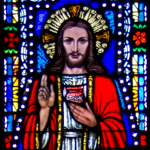
teaching

teaching
Showing posts with label Catholic Sacramental Imagination. Show all posts

Thursday, December 25, 2014

#18 The Liturgy and the Incarnation: Understanding the Mass and Its Parts


Today we celebrate the great mystery of faith: the Incarnation of the Son of God who became human in the Virgin’s womb by the power of the Holy Spirit. He is the Savior and Messiah, Christ Jesus the Lord. In Christ Jesus God and humanity become united not just in a spiritual way only, but the Son of God united himself to our material, bodily life, our flesh ("incarnation" means "to become flesh").

Everything that Jesus, the Son of God, did while on earth was done in and through his human body. He shared fully in the human condition, except not sinning, and remained fully God. He used his body and his words, his teaching and his use of the things of creation, his death and his Resurrection to reveal God’s life and love for us.

 
The Son of God came as Jesus to mediate our relationship with the Father in the power of the Holy Spirit. He reveals God the Father to us and it is through Christ that we come into a saving relationship with the Father. United to Christ in Baptism, we are united to the Father and the Holy Spirit, as well, for the Three are One God.

When we turn to the matter of the Liturgy and consider the Incarnation of the Son of God, we can see a principle at work: the Risen Christ, in and through his Body the Church, puts us in relationship with God the Father through the human relationships and the use of the things of creation in the Liturgy and beyond the Liturgy.

This is particularly important to understand "the stuff" Catholics use in the Liturgy of the Eucharist. If the Liturgy of the Word emphasizes primarily "hearing Christ," then the Liturgy of the Eucharist emphasizes the other senses as a way of encountering Jesus.

 
This Incarnation Principle gives rise to the "sacramental approach" of Catholicism (For more on the Sacramental imagination see HERE). Our worship of God is very symbol friendly, very creation friendly, very "down to earth" (the meaning of Christmas is that God came down to us). In our worship, we are also  lifted up to heaven, (the transcendent dimension of Litugy). Pope St. Leo the Great taught: "What has been visible of our Savior has passed over into the sacraments."

The implications of this are many. Regarding the Liturgy, one source states:

"The Church celebrates the liturgy using an abundance of signs, symbols, and rituals. We celebrate the Sacraments with scriptural readings, homilies, music, processions, blessings, bread, wine, oil, arms outstretched in prayer, gestures of peace, bowed heads, kneeling, standing, sitting, incense, holy water, flowers, candles, colors, ritual vestments, choirs, and musical instruments.

"We do this in a holy environment in which architecture, sculpture, paintings, icons, and stained glass lend an ambience that speaks of the mystery of God and divine transcendence on the one hand, and the unity of God with the worshiping community on the other. Since the Son of God honored us by becoming incarnate—the true visible image of the invisible God—we use these signs and symbols to help us experience God’s invisible presence." (From Liturgy resources of the Archdiocese of Minneapolis-St. Paul)

What follows now is a closer look at the parts of the Liturgy of the Eucharist. We shall look at the symbols and materials used in the Liturgy of the Eucharist and examine their meaning as part of God’s saving love which we encounter tangibly in the worship of the Church.

Next Week: The Offertory and Gift-Giving of the Mass

Thursday, November 27, 2014

#14 The Homily in the Liturgy of the Word. Understanding the Mass and Its Parts.


After the Gospel is proclaimed all sit and the Ordained Minister preaches a homily.

Homily comes from the Greek word meaning "a familiar conversation." The homily was originally given in the early Church as a kind of informal preaching, which would make sense for the usual small gatherings of Christians to worship.

 
Like the proclamation of the Scriptures where Christ speaks to us, his People the Church, so he also speaks through the preacher. Catechism #888 teaches us that "Bishops, with priests as co-workers, have as their first task ‘to preach the Gospel of God to all...’ in keeping with the Lord's command. They are ‘heralds of faith, who draw new disciples to Christ; they are authentic teachers’ of the apostolic faith ‘endowed with the authority of Christ.’"

The preacher is the instrument that Christ uses to convey his message, but the preacher is an imperfect instrument and his weaknesses can impede that message as much as his strengths can enhance it. Yet still Christ can speak to us in the homily because of what the homily is meant to do: "The homily is a mutual search by preacher and congregation–a seeking after the voice of God." (Thomas K. Carroll, Preaching the Word, p.43)

This official definition of a homily is typical: "The purpose of the homily is to explain the readings and make them relevant for the present day." (Liturgiae instaurationes 2,a)

Several other basic definitions found on the web are:

"Broadly speaking, a homily attempts to apply the message of the Sunday Scripture readings to the lives of the people."

"The purpose of the homily is to provide insight into the meaning of the scripture and relate it to the lives of the parishioners of the church."

 
All are in agreement that the homily must begin with the Scriptures that were just proclaimed in the liturgy and that the homily is not independent of the liturgy, as if we take a break in the Mass for some "Bible study" and then go back to the Mass which is to praise and thank God and offer the sacrifice of the Mass.

Sometimes it is helpful to know what the homily is not. It is not primarily teaching, Bible study, a lecture, or even what is very tempting in our culture: entertainment. A homily may very well contain elements of these things, but I find this quote instructive:

"The homily is not simply an explanation of the scriptures, the fruit of research into the best scholarship. Nor is it the drawing of a moral from the scriptures, nor using the scriptures to back up the latest need for school support or abortion law reform. Nor is the homily a great a great literary creation 'from nothing': the scriptures and eucharist are its beginning and its ending. The homilist helps the assembly appreciate the wonderful web that links word and sacrament and daily living." (Gabe Huck and Gerald T.Chinchar, Liturgy with Style and Grace, p.50)


Just like the rest of Mass, the homily is meant to facilitate an encounter with the living Christ, Jesus who is the Word made flesh, the revelation of the life of God as a loving communion of Father, Son, and Holy Spirit, and we are invited into this communion, this "exchang of love." (See Catechism #221 HERE)

Second, the homily also nourishes the "religious imagination" of the People gathered for Sunday worship. We live mainly by our images of reality, more than by our intellect. These images usually carry a great deal of emotional meaning for us. But our images of God and his vision for our lives and our world can be accurate or distorted. Hearing the Scriptures and the preaching in the Liturgy of the Word, in the context of the Church’s Tradition, should give us the right images to nourish our relationship with God and the Church. (See more on this matter of imagination Here and HERE)

The U.S bishops document, "Preaching the Mystery of Faith: The Sunday Homily" (issued January 2013) affirms the role of religious imagination in preaching:

"Jesus was not an abstract preacher but laced his preaching with rich images and provocative stories...

"But Jesus was not content simply to cite ordinary examples; there is in Jesus’ parables a quality of strangeness, something out of the ordinary, that grips the imagination and triggers wonderment on the part of the hearer."


Third the homily gives us a vision of how God wants our world to be like and calls us to be agents of change in our world, to begin to build what is Biblically called "the kingdom of God." Essentially, the Kingdom of God is the rule of God’s love. The homily explores what it would be like if we lived in that love and if that love changed the world into something infinitely better. Of course, this vision calls us to repent from whatever is unloving in us, i.e. sin.

Fourth, the homily, as part of the liturgy, points us implicitly and explicitly to how Jesus came to inaugurate God’s Kingdom of love by his Death and Resurrection. His Cross proclaims Christ’s sacrificial love for, which is how God loves us, and the Resurrection assures us that this love never ends.

Again the U. S. Bishops teach:

"Every homily, because it is an intrinsic part of the Sunday Eucharist, must therefore be about the dying and rising of Jesus Christ and his sacrificial passage through suffering to new and eternal life for us. By means of that pattern, the People of God can understand their own lives properly and be able to see their own experience in the light of the Death and Resurrection of Jesus." (ibid)

Lastly, the homily is meant to lead us into thanksgiving (Eucharist) and to offer ourselves with Christ’s One Sacrifice in the Eucharist–the service of his sacrificial love in dying and rising with him  and to be prepared to go out and live the faith proclained in Word and Sacrament.

"As part of the entire liturgical act, the homily is meant to set hearts on fire with praise and thanksgiving." (Ibid)

 
No homily can do all of this in less than 10 minutes! Which is again why it is important, moreover essential, that we attend Sunday Mass every Sunday. Only in this way will we progress in our understanding of how to live as God’s children in this world.

Next Week: The Creed

Return to Home Page

Thursday, September 18, 2014

#4 Preparation for the Sunday Mass: Series on Understanding the Mass and Its parts


Once we arrive at the Church we do a number of actions which help us prepare to celebrate the Mass on Sunday. Much of this is very familiar to us, but its good to review because we live in a society that is very casual about many things which deserve deeper appreciation and forethought.
 
First, we enter into the Church building itself. There are a number of blessings to remember as we enter into this sacred Space. The Psalmist prayed: "I rejoiced when they said to me, ‘Let us go up to the House of the Lord.’" (Psalm 122:1)
 
"I rejoiced when they said to be: 'Let us go up to the House of the Lord.'"
 
Our mind set is very important as we enter the Lord’s House. If we enter with an expectation that we will be bored and hoping to get through the Mass as quickly as possible we will get as little as we expect. But is we enter remembering that we gather as the Church with others to give God thanks and praise, and to be renewed in the Sacrifice of Christ and his love for us, then we will receive as much as we expect and more.
 
The Church is God’s House and the place where God’s Family gathers in a visible way. It is a consecrated place, meant almost exclusively for the worship of God. The interior of the Church building is usually divided into three parts: the vestibule (or entry space), the nave (or main worship space), and the sanctuary where the Word of God (the Scriptures) are proclaimed and the Eucharistic Sacrifice offered on the central altar.
 
 
The vestibule is a kind of lobby area, a transition place between the outside world and the actual place of worship (the nave). In other words, we do not normally pray in the vestibule, but we might. Our vestibule at Holy Faith highlights many features of the parish's service in Christ. There we collect food for the poor and other goods for those in need, and see displays of the various parish events on bulletin boards. The vestibule is also a place of being welcomed to Mass and conversations can freely occur before entering the main worship place.
 
Nave of St. Patrick Church in Lowell, MA:
notice "ship-like" ceiling
 
 
Once we enter the main part of the Church building, called the nave (cf. to "naval" or ship, because often the vaulted ceiling of a church resembled an upside down ship or it may refer to the Christian symbolism of the Church as the ship of Christ ) This is sacred space. Reverence is expected when one enters the nave. Especially before Mass, silence is supposed to be observed and talking kept  low so that we may prepare for Mass in silent prayer.
 
The main worship space is not a common place and so one does not eat or drink anything in the main part of the Church except the Consecrated Bread and Wine. As we enter this space, typically we will find holy water fonts at the various doors so that we may dip our hand into the blessed water and sign ourselves with the Sign of the Cross. This is a reminder of our Baptism by which we have the right to participate in the Eucharist of the Church who are the Baptized in Christ and his Body as the Church.
 
As we look around we will usually see images and statues of the Saints and Mary. We belong to the whole Church, a portion of which is in Heaven. We may also see stained glass windows and candles and various religious symbols, all reminding us that this is a Sacred Place. This is part of our "Sacramental or Catholic imagination" by which we use created and human realities to express and inspire our knowledge of God. (See more on Catholic imagination HERE)
 
Annunciation Catholic Church, Houston
 
 
The third main part of the Church is the sanctuary. It is usually elevated, requiring several steps up to where the altar is located, the seat where the Priest or Bishop sits, and the ambo or pulpit where the Scriptures are proclaimed. It symbolizes the Heavenly Church or simply Heaven. I will talk more about the sanctuary  in a futre entry in this series. However, here is an entry from "Pastor's Writings & Weblog" that compliments what is written here (See THIS).
 
Continuing our entry into the Church, we should be able to locate where the Blessed Sacrament is kept reserved in the stationary receptacle called a Tabernacle. A lamp is kept lighted near it, usually a red candle holder with a lighted candle, and it is kept always burning to indicate that here is where some of the Consecrated Bread by which Christ is Really Present is kept for Communion of the sick and for our adoration.
                                                            
When we enter our pew we genuflect, touching our right knee to the ground as a sign of reverence that Christ is truly present in the Blessed Sacrament. Then as we chose a place in the pew to sit, we should kneel or sit in prayer before Mass. This is a time of immediate preparation for the celebration of the Mass. There are several things we may pray about as we wait for Mass to begin. The Eucharist means "thanksgiving" in Greek. So one thing we can do is call to mind what we want to give thanks to God for in the Mass.
 
We probably will bring various needs to prayer also, such as prayer for our families, or for a job or some other need, or for the poor. We certainly can pray for those gathering in the Church for Mass. We gather to be united by the Holy Spirit to the One Sacrifice of Christ, in the service of his sacrificial love in our spiritual dying and rising. We can prepare to offer ourselves.
 
The Crucifix over the altar in many Catholic Churches reminding us of Christ’s Sacrifice on the Cross out of love for us, and also the Resurrection in which this love never ends, because of course Christ is Risen from the dead after being crucified.
 
We might also pose a question for ourselves as we prepare: "What dose God want to say to me today? May I listen for his guidance." Fr. Matthew Kelly, a dynamic teacher of the Catholic Faith says that God’s will for our lives is for us to become the best version of ourselves that we can become. I will explore this more as we go along. He suggests worshipers keep a journal that they bring to Church and write down one thing received at Mass that Sunday that can help them become God’s best version of themselves .
 
Obviously, little of this prayerful preparation can be done if people are having all kinds of conversations around us. Of course, we are not to be unwelcoming so that if people greet us we greet them. But that should be it–the full range of good conversation with others can occur after Mass and at the place of hospitality after Mass (in our parish, at the patio). There is nothing unfriendly about this. We prepare for Mass in silence beforehand; we sing and worship together in full voice during Mass; and after Mass we visit with one another and "meet and greet."
 
There is a "remote preparation" that can also take place before we gather at the parish Church. It would be wonderful if sometime during the week before Mass we read the Sunday Scripture Readings and perhaps some commentary upon them (See Loyola Press' "The Sunday Connection HERE). Also anything that helps us understand the Mass and the deeper meanings of Mass can help prepare our minds and hearts for the Sunday Mass.
 
Next Week: Introductory Rites of the Mass
 

Thursday, February 20, 2014

The Catholic Imagination is a Sacramental Imagination (Part II)

In my post for February 12, 2014 (HERE) I laid a foundation for understanding in a positive way the role of imagination in our lives as helping us to image reality; and that in relationship to "God-matters" ("religious realities") part of our imagination involves a "religious imagination." I then began to describe the Catholic Imagination. The most distinctive way that Catholic Imagination is defined is to say that Catholic Imagination is a "sacramental imagination." 
 
Moses and the Burning Bush:
God is revealed in creation and fire
 

1. What is meant by the term "sacramental imagination"? One author notes:
 
"Thus a sacramental world view [this applies to sacramental imagination], rooted in God's revelation to humanity, especially in the Incarnation, is experiencing God acting within the world in which we live, the world in which God chose to dwell for the sake of our salvation.
 
"For instance, nature, smells, sights, sounds, people, books, words, etc, can all have a sacramental character, in that God can supply grace, enliven, and enlighten us through diverse physical vehicles. While the classically accepted sacraments are sure means of grace, these [other] "sacramental experiences" are more subjective, and depend more on what God intends to do. E.g., nature does not always have a sacramental character, but can. This depends on God's intended activity in the world, an activity that I tend to see as more of a complex numinous web than anything linear. Why one hiker discovers God through nature, and another scorns God, we cannot know." (See David Bennett, "Sacraments: Meeting God in Our Own World," LINK)
 
Now when we who are Catholic hear that God uses creation and human relationships and experiences to communicate his life to us, we probably think "Well of course he does!" That’s because this is the nature of the Catholic sacramental imagination. But our Protestant neighbors would be much more cautious about accepting this.
 
One of the ways we can understand the Catholic sacramental imagination is to contrast it with the Protestant religious imagination or approach to living the Christian faith. It must be always remembered that Catholics and Protestants are both Christian, but have differences in the ways God and the realities of God are imaged (imagined).


2. Thus, in Christ Jesus, the Catholic religious imagination tends to be:

"symbol-friendly" and "creation-friendly"


3. By contrast, the Protestant religious imagination tends to be somewhat "symbol cautious" (and some forms of Protestantism, such as Southern Baptist, are very limited in their use of symbol). The Protestant religious imagination is restrictive in the use of created and human realities, and is thus:

"symbol-cautious" and "creation-cautious"

Another, colloquial way of stating the difference is that  Protestants tend to believe that "stuff" can get in the way of knowing God in Christ Jesus. Most Catholics would believe that "stuff" (creation, human relationships, the Church, etc.) is helpful, even essential to knowing God in Christ Jesus.

4. The Protestant religious imagination is mainly nourished by the Bible. Most Protestant churches, if they have sacraments, have two: Baptism and the Eucharist (or "the Lord’s Supper"). The Catholic religious imagination is also nourished by the Scriptures, and through Seven Sacraments, but also in "the stuff" of our world.

Much more has to be explained and I shall return to this topic to teach more about it in the future. Next week, we will be able to examine some images given us in the Season of Lent that are to guide us in our Catholic spiritual journey.


Thursday, February 13, 2014

The Catholic Imagination (Part I Introduction)

"Catholics live in an enchanted world,
a world of statues and holy water, stained glass and votive candles,
saints and religious medals, rosary beads and holy pictures.
But these Catholic paraphernalia are mere hints
of a deeper and more pervasive religious sensibility
which inclines Catholics to see the Holy lurking in creation.
As Catholics, we find our houses and our world
haunted by a sense that the objects, events, and persons of daily life
are revelations of grace."

(Andrew Greeley, Catholic Imagination, p.1)


This first entry of this blog for teaching the Catholic Faith and Culture is foundational: it is about the Catholic Imagination which Andrew Greeley in the above quote says is a "pervasive religious sensibility" of being Catholic. Throughout this blog I will share about and reflect upon the meaning of this Catholic Imagination.
 
First, I realize that the term "imagination" is a tricky one. I looked up the word imagination and found these definitions:
 
  • 1.The image-making power of the mind; the act of creating or reproducing ideally an object not previously perceived; the ability to create such images. "Imagination is one of the most advanced human faculties."  
  • 2. Particularly, construction of false images; fantasizing. "You think someone's been following you? That's just your imagination." 
  • 3.Creativity; resourcefulness. "His imagination makes him a valuable team member."
 
I and others who write about the Catholic Imagination are not using the term "imagination" in the second sense of this definition, i.e. as fiction or fantasy. Rather we mean the first and even the third meanings, i.e. imagination is the human faculty for "imaging reality" and it is a creative faculty.
 
1. Imagination and Reality
 
How we "image" (make mental pictures) of reality influences our experiences of reality. Our experiences of reality also influence our imagination.
 
Example: The concept of "Mother" will call up in our minds images of motherhood: our own mother, other mothers, mothers of the past, mothers of our time, the Madonna and child, "mother earth," etc. These images together will influence one’s expectations and experiences of motherhood.
 
Sometimes we are conscious of the images of motherhood or same other reality in our life and sometimes our images are not conscious to us. Perhaps one had a very bad or abusive mother. That may taint all other images of motherhood for that person. Perhaps the person is aware of this or it may be deeply embedded and unconscious in the person's soul.
 
I believe that quite often we live from our images of reality without thinking much about them. But imagination can (and must) be examined by reason or reflective thought and corrected and even healed. I’ll say more about that in a later entry.
 
As long as we live we are constantly "collecting" images of reality. Our images are being reinforced or refined. Our images can be good or faulty; but without the ability to image reality, how would we be able to picture reality in the first palce?
 
 
2. The Religious Imagination
 
It is asserted that a similar process occurs in our imaging of God and the relationships and "things" connected to God. This is the "religious imagination" which we could call a part of our entire imagination. Remember, we are not saying that God is imaginary (a fiction or fantasy; I said we are not using meaning #2 from our above definition).
 
Our images of God will also influence how we experience God in our lives. Many of our images of God were given to us before we could reason or think much about them (usually as children). Most of the images, again, are unconscious.
 
We can and we must think about our images of God and religious reality, to make sure they are true. This is why it is so important that the authentic Gospel and Church Tradition be proclaimed and taught to correct any misconceptions in our images of God. Imagine what kind of experience of God one would have had when the famous 18th century Puritan preacher Jonathan Edwards preached a sermon called "Sinners in the hands of an angry God." In fact as he preached some people wept, and some even fainted! In Scripture, we can find instances of God’s anger, but the core revelation and image is that "God is love." (1 John 4:8) Which image is the basic or primary  image of God? The answer to that "image" question is very important!
 
3. The Catholic Imagination 
 
The Catholic religious imagination tends to use a wide range of created and human realities to image God and God-relationships, culminating of course in Christ Jesus, the Image of God (see Col. 1:15). Jesus is the fullness of God’s revelation, "the Word made flesh."
 
Thus, Catholics (but not exclusively Catholics) use water, bread, wine, light, oil, human persons and relationships, etc. to image God and relationship to God. But Catholics are Christians, and so we interpret our use of created things and human realities in light of the life, death, Resurrection, and giving of the Holy Spirit of Christ Jesus.
 
Other religious systems may make lavish use of creation in their worship, for example Hindus. But the difference is crucial: the Christian experience always interprets reality in the revelation of Christ Jesus.


More next week.