teaching

teaching
Showing posts with label Heavenly Liturgy. Show all posts

Wednesday, May 6, 2015

#37 The Great Amen. Understanding the Mass and Its Parts.


The Eucharistic or Final Doxology concludes with the people responding "Amen!." This is often referred to as the "Great Amen."
 
Christian prayer and worship originated from our Jewish roots of Temple and Synagogue worship. Three words in the original Hebrew are found in Christian liturgical prayer: Alleluia, hosana, and amen. The word "Amen" means "It is so," "it is true," "So be it." It is an affirmation that comes at the end of blessings and prayers and signifies that the listeners agree with the prayer and desire it to be answered and done according to God’s will.
 
The Great Amen is significant at the conclusion of the Eucharistic Doxology. Last week I pointed out that this Doxology sums up the entire Eucharistic Prayer. It directs the Eucharistic Prayer Godward, praying that all glory and honor be given to God through the One Sacrifice of Christ offered in the Eucharist.
 
The Priest sings or says this Final Doxology and it is the People’s role to proclaim the "Amen!" Fr. Jeremy Driscoll, OSB, in his book What Happens at Mass, notes:
 
"To this doxology--to the entire Eucharistic Prayer-- the assembly sings ‘Amen!’ It is no wonder that this is often called the ‘Great’ Amen, because ‘This is the biggest Amen of the Mass and so is the biggest Amen in the world’ .... This Amen contains all the others. ...In the Mass, from our own place and time, we are spliced into this eternal Amen, and we shall sing forever what we are singing now. Amen!" (pp. 107-108; emphasis added).
 
 
The "eternal Amen" of which Fr. Driscoll speaks is the "Amen" of the Heavenly Liturgy of Christ with his Angels and Saints, and with Mary his Mother. As Father Gabriel of St. Mary Magdalene writes:
 
"The Saints...never cease giving thanks to God and with a loud voice they sing: 'Salvation belongs to our God who sits on the throne, and to the lamb!' [Revelation 7:10]. This is answered in heaven by the eternal 'Amen' of the angels, prostrated before the throne of the Most High [Revelation 7:11-12]; and should be answered on earth by the 'Amen' of the whole People of God as they journey toward their heavenly homeland, striving to emulate the holiness of the elect." (Meditation # 398. All Saints in Divine Intimacy vol. 4)
 
In the Book of Revelation the heaven liturgy is described with a number of doxologies sung by angels, saints and the blessed of heaven. And a number of those doxologies result in a glorious response of "Amen." (See examples HERE)
 
Some scholars believe that the Book of Revelation was describing elements of early Christian worship mirroring the worship of heaven. Certainly the Church’s liturgy would pick up elements of the Book of Revelation in her worship.
 
One of the earliest accounts we have of a the Eucharist as celebrated around 150 AD is by Justin Martyr. It could be written today. He writes:
 
"As soon as the common prayers [the General Intercessions] are ended and they (the Christians) have saluted one another with a kiss, bread and wine and water are brought to the presider, who receiving them gives praise to the Father of all things by the Son and Holy Spirit and makes a long thanksgiving [Greek: eucharistia] for the blessings which He has vouchsafed to bestow upon them, and when he has ended the prayers and thanksgiving, all the people that are present answer with the acclamation 'Amen'". ( Apol., lxv, P.G., VI, 428).
 
Hopefully, what may have been for you a simple response of "Amen" at the end of the Eucharistic Prayer can now be more fully appreciated for its significance, meaning and importance for what we do in the Mass. At Communion we say "Amen" ["it is so"] when receiving the Body and Blood of Christ, so we make a personal and communal acclamation of faith to what has happened during the Eucharistic Prayer to the glory of God: Father, Son, and Holy Spirit.
 
To listen to a magnificent "Amen" set to music, go HERE for the "Amen" from Handel’s Messiah.
 
 
Next Week: The Communion Rite: Revisiting the Sacrifice of the Mass.


Thursday, February 12, 2015

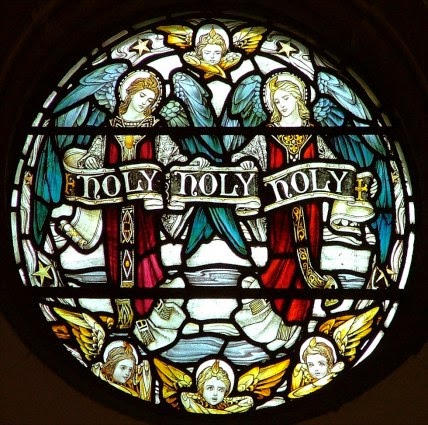
#25 Joining the Heavenly Liturgy in the Sanctus (Holy, Holy, Holy) of the Eucharistic Preface.


At the conclusion of each Eucharistic Preface is a call for us to join in the Heavenly Liturgy of Christ and his angels and his saints. This is the worship that goes on in heaven. We join in the angelic hymn of praise described by the Prophet Isaiah in his vision of heaven:
 
"I saw the Lord seated on a throne, high and exalted,
and the train of his robe filled the temple. 
 
Above him were seraphs, each with six wings:
with two wings they covered their faces,
with two they covered their feet, and with two they were flying. 
 
And they were calling to one another:
‘Holy, holy, holy is the LORD Almighty;
the whole earth is full of his glory.’ " (Isaiah 61-3)
 
The author of the Book of Revelation had a similar vision of the seraphim and their song:
 
"Each of the four living creatures had six wings and was covered with eyes all around,
even under its wings. Day and night they never stop saying:
‘Holy, holy, holy is the Lord God Almighty,
who was, and is, and is to come.’" (Revelation 4:8)
 
 
We echo this angelic song on earth in every Mass with what is commonly termed "The Sanctus" (Latin for Holy). The Sanctus is introduced within the Eucharistic Preface with reference to the angelic hosts and heaven itself. For example, this reference in a Eucharistic Prayer for Feasts of Mary:
 
"Through him [Christ] the Angels praise your majesty,
Dominions adore and Powers tremble before you.
Heaven and the Virtues of heaven
and the blessed Seraphim worship together with exultation.
May our voices, we pray, join with theirs in humble praise, as we acclaim:
 
Holy, Holy, Holy..."
 
I particularly like the Orthodox Church’s Liturgy of St. John Chrysostom with this introduction to the angelic hymn:
 
"For all this we give thanks, for all things known and unknown,
all benefits manifest and hidden... and also this Liturgy,
which God deigns to accept from our hands,
though before Him stand thousands of archangels
and myriads of angels, cherubim and seraphim,
six-winged, many-eyed soaring aloft on their wings,
singing, crying out and shouting the triumphal hymn:
 
Holy, Holy. Holy..."


In the Roman Rite the Sanctus quotes Isaiah 6:3, but adds the word "heaven," and also a reference from Matthew 21:9. Thus:
 
"Holy, Holy, Holy Lord God of hosts,
Heaven and earth are full of your glory:
Hosanna in the highest.
Blessed is he who comes in the name of the Lord.
Hosanna in the highest."
 
Here is a perfect hymn for us to join in heaven, and a foreshadowing of the coming of the Lord Jesus in the Eucharist.
 
 
The Sanctus brings us into the very precincts of heaven. With Christ and through him we offer worship in heaven as on earth. There, in heaven, he offers himself in an eternal offering of worship and love to God, with all his glorified members: the Virgin Mary and all the saints, accompanied by the angelic hosts. This is the "heavenly liturgy""It is in this eternal liturgy that the Spirit and the Church enable us to participate whenever we celebrate the mystery of salvation in the sacraments." (CCC1139).
 
We are also reminded of our union with heaven in the devotional decorations of the church. For example, flanking the Crucifix in our parish church are the panels of Mary and St. John. An icon of the Risen Christ is at the back of the Church. Above are angel banners. In two upper corners of the church are large banners of St. Joseph and the Madonna. And lo and behold, the stain glass windows near the sanctuary have those seraphim, the six winged angels, whom we join in their eternal hymn.
 
Next week: The Sacrifice of the Mass


Thursday, January 22, 2015

#22 Just Between Us: Dialogue of the Preface of the Eucharistic Prayer. Understanding the Mass and Its Parts


The Eucharistic Prayer is the central prayer of the Mass. It begins with a dialogue between the Priest (or Bishop) and the People. It is inspiring, as we shall see, that every sentence of the Eucharistic prayer is meaningful, especially for those who become knowledgeable about the Mass, as you are doing.
 
The Dialogue begins what is called the Preface of the Eucharistic Prayer. The Dialogue is as follows:
 
Priest: The Lord be with you.
People: And with your spirit.
 
Priest: Lift up your hearts.
People: We lift them up to the Lord.
 
Priest: Let us give thanks to the Lord our God.
People: It is right and just.
 
The first exchange is a type of greeting between the Priest and the People. We have heard it before in the Mass: at the beginning of the Mass after the Sign of the Cross; before the Gospel is proclaimed; it will also be exchanged at the "Kiss of Peace’ (in this form, Priest: "The peace of the Lord be with you." People: "And with your spirit."). Finally it is said at the Dismissal.
 
This was one of the changes that came about with the new translation of the Roman Missal in 2011. The greeting was once said in this way: Priest: "The Lord be with you." People: "And also with you." However, the original Latin of the authoritative text of the Mass has the People’s response as "Et cum spiritu tuo," i.e., "And with your spirit." This has a meaning not captured in the response "And also with you."
 
So what does this greeting mean and how is it meaningful for us in the Mass?
 
First, the Priest and the People are together entering into a holy work (the root meaning of the word "liturgy" is "public work"). We are being united with the Prayer of the Risen and Glorified Christ in the Liturgy of Heaven.
 
Painting by Pietro Cavallini
 
The Mass is not our action alone nor is it initiated by us. Rather, by our union with Christ in Baptism, we share in his worship of God the Father. God has initiated our worship and the Son of God perfectly worships the Father in his glorified humanity. In this union, we are the Body of Christ and we participate in the Prayer of our Head, our Leader and Lord, Christ Jesus. As the Catechism states:
 
"The liturgy is also a participation in Christ's own prayer addressed to the Father in the Holy Spirit. In the liturgy, all Christian prayer finds its source and goal. Through the liturgy the inner man is rooted and grounded in ‘the great love with which [the Father] loved us’ in his beloved Son. It is the same ‘marvelous work of God’ that is lived and internalized by all prayer, ‘at all times in the Spirit.’" (#1073)
 
I remember what a revelation this was for me when I first realized that it is Christ’s worship that we join in every time we celebrate the Eucharist. What dignity is conferred upon us in this divine act of which we are a part!
 
 
So at the beginning of this divine work, knowing that this is a work rooted in the Triune God, the Priest wishes or expresses what must happen to enter into this prayer. So he says: "[May] The Lord be with you." You see, only with the Lord can we do this Christian worship, Christ’s worship. And the People respond in a similar way to the Priest; "And [may the Lord be] with your spirit."
 
This response "And with your spirit" is only said to an ordained minister (a Bishop, Priest, or Deacon). Commentators on this use of the word "spirit" propose that what is being referred to is the grace of the ordination of the minister given to his spirit. In the context of the Eucharistic Prayer, when only a Priest (or Bishop) is saying this greeting, the U. S. Bishops note:
 
"The Priest, by the spirit given him at ordination, is about to act in the person of Christ to consecrate the bread and wine into the Holy Eucharist."
 
You see, the Priest (and Bishop, supremely) is consecrated in Ordination to be able to represent "Christ the Head of the Church."
 
 
The second exchange of the Preface Dialogue is understood as "a turn toward" heaven, and more specifically entering that aforementioned "Heavenly Liturgy." (For more sgo HERE) As the Catechism teaches:
 
"The liturgy is the work of the whole Christ, head and body. Our high priest celebrates it unceasingly in the heavenly liturgy [i.e., in heaven], with the holy Mother of God, the apostles, all the saints, and the multitude of those who have already entered the kingdom." (#1187)
 
Our worship is not merely a social gathering concerned only with this world. Our worship is a transcendent event, "heaven on earth," and so should have an exalted dimension. Thus the Priest exhorts: "Lift up your hearts." But to where are we lifting our hearts up? To heaven, to the Lord.


The People respond, "We lift them up to the Lord."
 
Our hearts denote our entire selves. St. Thérse de Lisieux said "For me, prayer is a surge of the heart; it is a simple look turned toward heaven, it is a cry of recognition and of love, embracing both trial and joy."
 
 
The final exchange is also rich in meaning. The Priest says, "Let us give thanks to the Lord." As it is often pointed out, the original Greek for "thanksgiving" is "eucharistia." (Greek was the original language of the Mass at the beginning) And the People respond: "It is right and just."
 
 
Justice in its Biblical meaning is "right relationship" and doing what is right. One web site notes:
 
 
"St. Thomas Aquinas reminds us that we participate in Mass as an act of justice, giving God the praise and thanksgiving that is his due. It is not so much about what we ‘get out of Mass’ but instead what we bring to Mass.
 
  "Christian worship is about praising and thanking God in community as we recall God’s blessings and as we rediscover our own identity as Christ’s body in this world.
 
  "Gathering every Sunday for Mass challenges us both as individuals and as a community to live differently because of the worship we celebrate. Authentic worship fills our hearts with gratitude and leads us to deeds of justice.
 
 "We are missioned to "go" from Mass and live each day lifting our hearts to the Lord, aware of God’s glory in creation and thanking and praising God, because it is right and just."
 
(www. blog.renewintl.org/it-is-right-and-just)
 
Next Week: "The Preface of the Eucharistic Prayer: Why we Give Thanks and Worship"
 

Thursday, May 29, 2014

Christ and Our Ascending to Heaven


This Sunday is the Feast of the Ascension (transferred from Thursday to Sunday in our Diocese and in many others). We profess that the Risen Christ ascended into heaven after his Resurrection. What is the significance of this for Christ Jesus and for us, his Church which is united to him?

First, the Risen Christ takes his transformed and Risen human nature, body and soul, into the dimension (so to speak) of Heaven. Heaven transcends space and time. It is neither "up" nor "down," and it is not a "location" as we think of it but rather like another dimension, "the invisible world."

Pope Francis says:

"The Lord’s Ascension means that Christ has not gone far away from us, but that now, thanks to the fact that he is with the Father, he is close to each one of us forever."

"He is no longer in a specific place in the world as he was before the Ascension. He is now in the lordship of God, present in every space and time, close to each one of us." (General Audience, Wednesday, 17 April 2013)

If Christ had remained only in our dimension, this visible world, he could not have been Lord of both heaven and earth in his humanity. He is already the "Son of God from Heaven," as the Second Person of the Trinity; through his Resurrection and Ascension he is now also "the Man of Heaven." As the Catechism says, "The Father's power ‘raised up’ Christ his Son and by doing so perfectly introduced his Son's humanity, including his body, into the Trinity." (#648). Our human nature cannot be raised up in dignity and glory any higher than this!


                                                                                 * * *

When Jesus ascends into heaven, he enters heaven as our Great High Priest. In the Jewish worship offered in the Temple, the High Priest would enter annually into the inner sanctum, the Holy of Holies, on the Day of Atonement to offer the blood sacrifice of animals for the sins of the People. The author of the Letter to the Hebrews compares Jesus’ entry into heaven to this entry of the High Priest into the Holy of Holies. The Ascended Christ brings his own Sacrifice on the Cross for our sins before God and opens the way for us to follow him to heaven. (See Hebrews 4:14; 9:11; 10:19,20)


In heaven Christ is our Priest. He presides over the Heavenly Liturgy (worship) which includes the angels and saints and all the blessed of heaven. As Priest he offers his One Sacrifice, once offered on the Cross, i.e. himself in his Body and Blood. The Catechism (#1187) says about this Heavenly Liturgy:

"The liturgy is the work of the whole Christ, head and body. Our high priest celebrates it unceasingly in the heavenly liturgy, with the holy Mother of God, the apostles, all the saints, and the multitude of those who have already entered the kingdom."

Christ also makes intercession for us in heaven. (See Hebrews 7:25) This is why at our Sunday Mass, at the time of the Intercessions, we say we are joining our Intercessions with those of Christ.

When we celebrate our Eucharist on earth, we spiritually ascend to heaven, to participate by faith in the Heavenly Liturgy with Christ. I have learned a great deal about this "ascension in the liturgy" from an Orthodox Priest and Liturgical scholar, Fr. Alexander Schmemann. He writes:

"But the liturgy of the Church is always...a lifting up, an ascension. The Church fulfills itself in heaven in that new aeon which Christ has inaugurated in His death, resurrection and ascension, and which was given to the Church on the day of Pentecost as its life..." (For the Life of the World, p.42)

 The U.S. Bishops say much the same thing about Christ’s Presence in the Eucharist:

"Christ does not have to leave where he is in heaven to be with us. Rather, we partake of the heavenly liturgy where Christ eternally intercedes for us and presents his sacrifice to the Father and where the angels and saints constantly glorify God and give thanks for all his gifts." ( "The Real Presence of Jesus Christ in the Sacrament of the Eucharist: Basic Questions and Answers," USCCB, June 2001)

(The above section on the Heavenly Liturgy is taken from my former blog "Father’s Wrings & Weblog," from the entry "The Eucharist: Door to Heaven." For the entire entry see HERE)