teaching

teaching
Showing posts with label Eucharistic prayer. Show all posts

Wednesday, May 6, 2015

#37 The Great Amen. Understanding the Mass and Its Parts.


The Eucharistic or Final Doxology concludes with the people responding "Amen!." This is often referred to as the "Great Amen."
 
Christian prayer and worship originated from our Jewish roots of Temple and Synagogue worship. Three words in the original Hebrew are found in Christian liturgical prayer: Alleluia, hosana, and amen. The word "Amen" means "It is so," "it is true," "So be it." It is an affirmation that comes at the end of blessings and prayers and signifies that the listeners agree with the prayer and desire it to be answered and done according to God’s will.
 
The Great Amen is significant at the conclusion of the Eucharistic Doxology. Last week I pointed out that this Doxology sums up the entire Eucharistic Prayer. It directs the Eucharistic Prayer Godward, praying that all glory and honor be given to God through the One Sacrifice of Christ offered in the Eucharist.
 
The Priest sings or says this Final Doxology and it is the People’s role to proclaim the "Amen!" Fr. Jeremy Driscoll, OSB, in his book What Happens at Mass, notes:
 
"To this doxology--to the entire Eucharistic Prayer-- the assembly sings ‘Amen!’ It is no wonder that this is often called the ‘Great’ Amen, because ‘This is the biggest Amen of the Mass and so is the biggest Amen in the world’ .... This Amen contains all the others. ...In the Mass, from our own place and time, we are spliced into this eternal Amen, and we shall sing forever what we are singing now. Amen!" (pp. 107-108; emphasis added).
 
 
The "eternal Amen" of which Fr. Driscoll speaks is the "Amen" of the Heavenly Liturgy of Christ with his Angels and Saints, and with Mary his Mother. As Father Gabriel of St. Mary Magdalene writes:
 
"The Saints...never cease giving thanks to God and with a loud voice they sing: 'Salvation belongs to our God who sits on the throne, and to the lamb!' [Revelation 7:10]. This is answered in heaven by the eternal 'Amen' of the angels, prostrated before the throne of the Most High [Revelation 7:11-12]; and should be answered on earth by the 'Amen' of the whole People of God as they journey toward their heavenly homeland, striving to emulate the holiness of the elect." (Meditation # 398. All Saints in Divine Intimacy vol. 4)
 
In the Book of Revelation the heaven liturgy is described with a number of doxologies sung by angels, saints and the blessed of heaven. And a number of those doxologies result in a glorious response of "Amen." (See examples HERE)
 
Some scholars believe that the Book of Revelation was describing elements of early Christian worship mirroring the worship of heaven. Certainly the Church’s liturgy would pick up elements of the Book of Revelation in her worship.
 
One of the earliest accounts we have of a the Eucharist as celebrated around 150 AD is by Justin Martyr. It could be written today. He writes:
 
"As soon as the common prayers [the General Intercessions] are ended and they (the Christians) have saluted one another with a kiss, bread and wine and water are brought to the presider, who receiving them gives praise to the Father of all things by the Son and Holy Spirit and makes a long thanksgiving [Greek: eucharistia] for the blessings which He has vouchsafed to bestow upon them, and when he has ended the prayers and thanksgiving, all the people that are present answer with the acclamation 'Amen'". ( Apol., lxv, P.G., VI, 428).
 
Hopefully, what may have been for you a simple response of "Amen" at the end of the Eucharistic Prayer can now be more fully appreciated for its significance, meaning and importance for what we do in the Mass. At Communion we say "Amen" ["it is so"] when receiving the Body and Blood of Christ, so we make a personal and communal acclamation of faith to what has happened during the Eucharistic Prayer to the glory of God: Father, Son, and Holy Spirit.
 
To listen to a magnificent "Amen" set to music, go HERE for the "Amen" from Handel’s Messiah.
 
 
Next Week: The Communion Rite: Revisiting the Sacrifice of the Mass.


Thursday, April 30, 2015

#36 The Conclusion of the Eucharistic Prayer: The Final Doxology. Understanding the Mass and Its Parts.


The Eucharistic Prayer ends with the Final Doxology and the Great Amen.There will then be 2 more parts of the Mass to examine: the Communion Rite and the Final Blessing and Dismissal.
 
A doxology acclaims the glory of God and often comes at the end of a longer prayer. It is different from the "Glory to God" hymn that is in the Introductory Rite of Sunday except in Lent and Advent. (See my previous discussion about glory HERE) The early Church adopted adding  a doxology to the end of psalms and certain prayers based upon  Jewish Synagogue practice.
 
The word "doxology" is derived from two Greek words: "doxa" meaning "glory" and "logos" meaning "speaking" or " word," Thus, a doxology speaks words of glory about God.
 
The Intercessions of the Eucharistic Prayer (examined last week) usually end with some reference to Christ that is then taken up in the Eucharistic Doxology. For example, in Eucharistic Prayer III, the final Eucharistic Intercession mentions the deceased, saying:
 
"To our departed brothers and sisters and to all who were pleasing to you at their passing from this life, give kind admittance to your kingdom. There we hope to enjoy for ever the fullness of your glory through Christ our Lord through whom you bestow on the world all that is good."
 
Then the Priest raises with one hand the ciborium with the Consecrated Hosts and with the other hand raises the Chalice with the Consecrated wine above the altar and says or chants:
 
"Through him, and with him, and in him, O God, almighty Father,
in the unity of the Holy Spirit, all glory and honor is yours, for ever and ever."
 
This Final Doxology in many ways sums up our worship and prayer at Mass.  The Catechism says: "...the Church celebrates public worship to the glory of the Holy Trinity, hears the word of God and sings his praise, lifts up her prayer, and offers the sacrifice of Christ sacramentally present in the midst of the assembly..." (#1199)


Icon of the Three Angels who visited Abraham:
Traditional Depiction of the Trinity
Icon by Peter Murphy
The Eucharistic Doxology is Trinitarian
 
We can note that this Final Doxology is Trinitarian: it hymns the Father, the Son and the Holy Spirit. We began the Mass invoking the Name of the Father, Son, and Holy Spirit. This also recalls our Baptism in the same Triune Name.
 
The Catechism highlights the significance of the Trinity in our life as the People of God:
 
"But St. John goes even further when he affirms that ‘God is love’ [1 John 4:16]: God's very being is love. By sending his only Son and the Spirit of Love in the fullness of time, God has revealed his innermost secret: God himself is an eternal exchange of love, Father, Son and Holy Spirit, and he has destined us to share in that exchange." (Catechism #221)
 
The Church "is the sacrament of the Holy Trinity's communion with men" and women. (Catechism #747) The Trinity reveals that God is loving relationship between the Three divine Persons who are one God. We are called personally and as members of the Church to foster the same kind of loving relationships in this world.
 

The Ancient Pattern of Prayer
 
This Final Doxology also reveals the ancient pattern of prayer that is still reflected in the Mass today. We give glory to God the Father, through–with–and in the Son and in the union (the unity) of the Holy Spirit.
 
Time does not permit an extensive discussion of this, but God sent his Son to be our Mediator and High Priest between the Father and the Church, God’s People and the Body of Christ. God the Father  wants to have communion with us through the Son made human, with the Son and in him. The Holy Spirit "facilitates" this communion. Our relationship with God is one of union, not just imitation.
 

Liturgical Prayer is Christ and His Body the Church at Prayer
 
This Doxology also underscores the teaching that at Mass it is first of all the Crucified and Risen Christ who worships the Father in the love of the Holy Spirit. Only Christ alone is worthy and able to worship God in an eternal act of total self-giving love.
 
Now we are united to Christ in our Baptism, and given the Holy Spirit to dwell within us. In the Mass this union makes us one with Christ in his worship, the supreme expression of his love. Does it seem strange that the Son would worship the Father when both are equally God? The worship of Christ is his worship in our human nature.


The Meaning of the Glory of God
 
Finally, what is this glory of God the Father through the Son and in the unity of the Holy Spirit? In the Old Testament the glory of God is revealed as God’s Presence in his actions to save us. This glory is often represented by radiant light: "Arise, shine; for your light has come, and the glory of the Lord has risen upon you." (Isaiah 60:1)
 
 In the New Testament, this glory of God is revealed in the saving Presence of Jesus Christ, the Son of God in his humanity and divinity. God is revealed to us in Christ’s humanity and as St Paul writes:
 
"For it is the God who said, ‘Let light shine out of darkness,’ who has shone in our hearts to give the light of the knowledge of the glory of God in the face of Christ." (2 Corinthians 4:6)
 
Jesus reveals the glory of God to be God’s love, "for God is love" (1 John 4:16), and this love shines forth in goodness, beauty and truth. Jesus prays:
 
"Father, I glorified You on the earth,
having accomplished the work which You have given Me to do.
Now, Father, glorify Me together with Yourself,
with the glory which I had with You before the world was...
so that they may see My glory which You have given Me,
for You loved Me before the foundation of the world." (John 17:4-5,22)
 
To glorify God, then, is to acknowledge that all glory belongs to God the Father and to live in that glory in union with Christ and the Holy Spirit. It means to "shine" with the love of God, with God's beauty, truth and goodness.
 
Next Week: The Great Amen & a Summary. Understanding the Mass and Its Parts.


Thursday, April 23, 2015

#35 The Intercessions of the Eucharistic Prayer. Understanding the Mass and Its Parts


Stretching back to the beginning of this series, I wrote that the first act of the Mass is the gathering of the Body of Christ, the Church on Sunday and at other times, as well. I wrote:

"Our life in Christ is not meant to be lived in isolation from others. That’s why Jesus gave us his Church. The whole Church is supposed to be visible on Sunday. We can’t make the Church visible by ourselves or alone; thus the whole Church is called to worship on Sunday

"God calls us together on Sunday to give witness that we are saved and called to be God’s family together, to be God’s People, to be the Church of Christ, the community of disciples. We cannot give witness to this alone, but we do it by gathering together on Sunday. Then we worship together, which is our higher purpose in life." (CITATION)

Last week I wrote about the Prayer for Unity in every Eucharistic Prayer. The Church gathers and is made visible in a given place, and we pray that through our union with Christ’s Sacrifice and receiving his Body and Blood we may become truly one as Christ’s Body the Church.
 

What follows as a result of this Prayer for Unity are Intercessions for the Church. If we are united to one another, then we show our concern and care for the members of the Church, first through prayer. As Catechism 1354 teaches us:

"In the intercessions, the Church indicates that the Eucharist is celebrated in communion with the whole Church in heaven and on earth, the living and the dead, and in communion with the pastors of the Church, the Pope, the diocesan bishop, his presbyterium [body of priests] and his deacons, and all the bishops of the whole world together with their Churches."

These Intercessions should not be confused with the General Intercessions or Prayer of the Faithful (See previous entry HERE) which occur after the Liturgy of the Word (following the Creed on Sunday). Those Intercessions can be and are very specific in what is petitioned while following a general pattern for what should be prayed. They are part of and a response of the Liturgy of the Word. They are opened and closed by the Priest (or presiding Bishop), but the petitions are prayed by a Deacon or a member of the laity.

The Intercessions of the Eucharistic Prayer itself are much more global. They are usually not very specific except to mention various members of the Church. As part of the Eucharistic Prayer they are prayed by the Priest in the name of the entire Church.


For whom do we pray in these Eucharistic Intercessions? As the Catechism indicates we pray with the Church in heaven (with the Intercessions of the Saints) and on the Church on earth. We pray for the living and the dead  (especially those in Purgatory being purified for heaven. For a lengthy reflection on Purgatory see HERE). We also pray for the ordained and the lay members of the Church on earth. And usually there is a prayer for all people, even those not formally part of the Church.

Let us look at an example of these Intercessions.  Eucharistic Prayer III, used the majority of the time for Sunday Mass, prays:

"May he make of us an eternal offering to you,
so that we may obtain an inheritance with your elect,
especially with the most blessed Virgin Mary, Mother of God,
with Blessed Joseph her spouse,
with your blessed Apostles and glorious Martyrs
(with Saint N.: the Saint of the day or Patron Saint) and with all the Saints,
on whose constant intercession in your presence we rely for unfailing help.

"May this Sacrifice of our reconciliation, we pray, O Lord,
advance the peace and salvation of all the world.

Be pleased to confirm in faith and charity your pilgrim Church on earth,
with your servant N. our Pope and N. our Bishop,
the Order of Bishops, all the clergy, and the entire people you have gained for your own.

Listen graciously to the prayers of this family, whom you have summoned before you:
in your compassion, O merciful Father, gather to yourself all your children
scattered throughout the world.

"To our departed brothers and sisters
and to all who were pleasing to you at their passing from this life,
give kind admittance to your kingdom.
There we hope to enjoy for ever the fullness of your glory
through Christ our Lord through whom you bestow on the world all that is good."
 

This set of Intercessions is particularly exemplary in its rich content. We see the Communion of Saints mentioned. (Pope Francis added the mention of the spouse of the Virgin Mary, blessed Joseph) The Intercession of the Saints is mentioned.

Notice that the advance of "the peace and salvation of all the world" is asked of God. The "pilgrim Church on earth" is mentioned, with the obligatory prayer for the Pope and the Bishop, as well as for the clergy (Priests and Deacons). A beautiful prayer in Eucharistic Prayer III asks the merciful Father "to gather to yourself all your children scattered throughout the world."

Finally in this Eucharistic Prayer we pray for our departed brothers and sisters to enter the kingdom of God (inferred to be in heaven).
 
Christ Intercedes:
Note in this image he is dressed as a Priest
 and has his hands lifted in prayer like a Priest at Mass


As the Catechism teaches "The whole Church is united with the offering and intercession of Christ." (#1369) As our High Priest "he is able for all time to save those who approach God through him, since he always lives to make intercession for them." (Hebrews 7:25) The Church, as the Body of Christ is united to Christ our Head and Priest to intercede in the Mass.
 
Next Week: The Great Doxology.


Thursday, April 16, 2015

#34 Prayer for Unity in the Eucharistic Prayer. Understanding the Mass and Its Parts


After the explicit offering of the One Sacrifice of Christ in the Mass, there follows in all the Eucharistic Prayers a petition that the Holy Spirit make all participants one in Christ and his Body the Church; however in the Roman Canon, i.e., Eucharistic I, this is implicit.
 
Here are some examples of this prayer for Unity in the Body of Christ:
 
Eucharistic Prayer II
 
"Humbly we pray
that, partaking of the Body and Blood of Christ,
we may be gathered into one by the Holy Spirit."
 
Eucharistic Prayer III
 
"Grant that we,
who are nourished by the Body and Blood of your Son
and filled with his Holy Spirit,
may become one body, one spirit in Christ."
 
Eucharistic Prayer IV
 
"Look, O Lord, upon the Sacrifice
which you yourself have provided for your Church,
and grant in your loving kindness
to all who partake of this one Bread and one Chalice
that, gathered into one body by the Holy Spirit,
they may truly become a living sacrifice in Christ
to the praise of your glory."
 
Here is the Prayer for Unity in Eucharistic Prayer for Reconciliation I which we use for Lent and the Easter Season at Holy Faith:
 
"Look kindly, most compassionate Father,
on those you unite to yourself
by the Sacrifice of your Son,
and grant that, by the power of the Holy Spirit,
as they partake of this one Bread and one Chalice,
they may be gathered into one Body in Christ,
who heals every division."
 
The first thing that we notice about these prayers and those in other Eucharistic Prayers like them, is that the unity that the prayer is referring to comes from partaking of Holy Communion, so the prayer is anticipating that moment in the Mass.
 
However, one can also see that the purpose of this Communion is  that we can be the One Body of Christ, the Church (also referred to as the "Mystical Body of Christ"). I will have more to say about this when we come to the reflection upon Holy Communion.
 
The Eucharist brings about the unity of the Church and it also expresses the unity of the Church.
 
Revered theologian Henri de Lubac gave us the the saying, "The Eucharist makes the Church, and [in turn] the Church makes the Eucharist." Essential to the Church is her unity. "I believe in one, holy, catholic and apostolic Church" (from the Nicene Creed). In addition, it is the Holy Spirit who brings about this unity:
 
"The Church is the Temple of the Holy Spirit. The Spirit is the soul, as it were, of the Mystical Body, the source of its life, of its unity in diversity, and of the riches of its gifts and charisms." (Catechism #809)
 
 
Before his death on the Cross, Jesus prayed for his disciples, for the Church: "that they may all be one; even as You, Father, are in Me and I in You, that they also may be in Us, so that the world may believe that You sent Me." (John 17:21)
 
We can also recall what was written earlier about Covenant (see HERE). The "Classical Covenant Formula" is when God chooses a people and says "I will be your God and you will be my People." This involves a People united in the worship of the One God and who live in justice and peace with one another. (See for example Micah 6:8 HERE)
 
The same call to worship God and to serve others expressed as love is central in the teaching of Jesus: love God with everything we are and love neighbor as ourselves (See Mark 12:29-34 HERE)
 
A final word about this unity expressed and brought about in the Eucharist through Christ and the Spirit: this is a unity in diversity, not an artificial uniformity in all things. As Pope Francis noted:
 
"The Spirit builds ‘the unity of the Church’ in the ‘diversity of nations, cultures, and people.’" (Papal Mass on 10-24-2014)
 
At the same time we have a "common core" (if I may use this term) of unity in the teaching of the Catholic Church, in the liturgical worship, and in communion with the Pope and Bishops of the Church. It is a unity that comes from union with Christ though the Holy Spirit, which is with God the Father. This union is supernaturally fostered in the Eucharist.
 
 
Next Week: The Intercessions of the Eucharistic Prayer


Thursday, February 26, 2015

#27 The Epiclesis and the Consecration. Understanding the Mass and Its Parts.

 
Jesus instituted the Eucharist at the Last Supper


The ancient understanding of the Mass is that the Risen and Glorified Christ is Really Present in the worship under the appearances of bread and wine that have been duly consecrated. There is a wondrous transformation of the ordinary bread and wine where the Risen Christ becomes present in a way he was not before the Consecration.
Thus Christ, through the ministry of the ordained Priest, truly offers his Body and Blood (his entire self) in his One eternal Sacrifice, sacramentally through the Consecrated Bread and Wine.

How is the bread and wine transformed through the ministry of the ordained Priest for the benefit of all who offer themselves with Christ in the Eucharist? The Catechism teaches that "At the heart of the Eucharistic celebration are the bread and wine that, by the words of Christ and the invocation of the Holy Spirit, become Christ's Body and Blood." (#1333)

The ordained Priest, by virtue of his ordination, is given a permanent role to represent Christ the High Priest and the Head of the Church (the supreme expression of this role is that of the Bishop). The Priest through his ordination is invested with a "sacred power" (an authority and service) to consecrate the bread and wine in the Eucharist to become Christ’s Body and Blood.

However, this "power" is accomplished by the Holy Spirit and the words of Christ which he spoke at the last Supper ("...this is my Body...this is my Blood...").

 
I. The Epiclesis

After the Sanctus is sung (and in the United States the Assembly kneels) there are a few words that serve as a transition to the Epiclesis. Epiclesis is a Greek word meaning "to call upon or from above," thus "to invoke," in this case the Holy Spirit. The Priest extends his hands over the bread and wine to be consecrated. This signifies the coming of the Holy Spirit by whose power Christ the High Priest will transform the bread and wine.


This gesture of the Bishop or Priest extending hands over some thing or person is a type of "laying on of hands" whereby the Holy Spirit comes to act upon that thing or to act in that person. Thus there is an epiclesis also in Confirmation, in Ordination, and in the Anointing of the Sick and in the Sacrament of Reconciliation when one goes "face to face" with the minister.

With the Eucharistic Epiclesis the Priest also makes the Sign of the Cross over the bread and wine when it is indicated. Thus in Eucharistic Prayer III the Priest prays:

"Therefore, O Lord, we humbly implore you: by the same Spirit graciously make holy these gifts we have brought to you for consecration, that they may become the Body and + Blood of your Son our Lord Jesus Christ at whose command we celebrate these mysteries."

We should remember a principle stated in the Catechism: "When the Father sends his Word, he always sends his Breath." (#689). The Word is Christ Jesus and the Breath is the Holy Spirit (note the play on words: the breath carries the spoken word, so the Spirit brings Christ and Christ comes with the Spirit). We are accustomed to believe that we receive Christ in the Eucharist; we also receive the Holy Spirit anew in the same Eucharist.


II. The Consecration

The act of Consecration signifies a dedication and a making holy. The words of Jesus spoken at his last Supper are given in a "Eucharistic version" and repeated by the Priest over the bread and the wine. Since it was at the Last Supper that Jesus instituted (i.e. established) the Eucharist to be done in his memory, this moment of the Mass is also called "the Institution Narrative."

The function of the Consecration as discussed earlier is to bring about the transformation of the bread and wine to become the Risen Body and Blood of Christ in the manner of a sacrament. But these words also tell God why we are doing what we are doing in the Eucharist. In the course of telling God we are also being reminded of why we do what we do.

There is always some short introduction to the words of Consecration. Thus in Eucharistic prayer III the Priest says:

"For on the night he was betrayed he himself took bread, and giving you thanks he said the blessing, broke the bread and gave it to his disciples, saying:..."

As the priest is saying the introduction, he takes the bread (a Host, from Latin for sacrifice or that which is sacrificed) in his hands and then when saying the words of Consecration he bows slightly (in reverence) and says:

"...TAKE THIS, ALL OF YOU, AND EAT OF IT: FOR THIS IS MY BODY WHICH WILL BE GIVEN UP FOR YOU."

The Priest elevates the Host slightly above the altar so that those present may adore Christ Really Present." Then putting the Host back on the altar, he makes a sign of reverence by genuflecting (going down on one knee and then rising back up). The People are already kneeling after the Sanctus.


Then he introduces the Chalice filled with wine. Again in Eucharistic Prayer III:

 "In a similar way, when supper was ended, he took the chalice, and giving you thanks he said the blessing, and gave the chalice to his disciples, saying..."

The Priest takes up the Chalice of wine while saying this and then again bowing slightly says:

"TAKE THIS, ALL OF YOU, AND DRINK FROM IT: FOR THIS IS THE CHALICE OF MY BLOOD, THE BLOOD OF THE NEW AND ETERNAL COVENANT; WHICH WILL BE POURED OUT FOR YOU AND FOR MANY FOR THE FORGIVENESS OF SINS. DO THIS IN MEMORY OF ME."


He lifts the Chalice slightly above the altar so that the People may adore Christ. The Priest genuflects after showing the Chalice.

III. Who is Addressed in the Consecration?
 
We must remember who is being addressed in this Institution Narrative. It is God the Father who is being addressed. Some Priests will take the bread and while they are saying the introduction to the Consecration they show the bread from right to left or left to right to the Assembly, obviously saying the words to the Assembly. The words "gave it to his disciples" is being used to include those in the pews, as the Priest says these words to them.

First, there is nothing in the guidelines of the Mass which says "At the Consecration, address the Assembly and show them the bread (or Chalice) while doing this." If the Assembly is being addressed in this introduction, then the words "and when he was giving you thanks" would mean he thanked his disciples! Then is the Consecration also addressed to the Assembly? If the Priest follows the guideline to bow at these words, then at least that mistaken possibility is avoided (no eye contact with the Assembly).

Instead, the Priest is addressing God in the Institution Narrative. He relates how Jesus gave God thanks and what he did with the bread and wine. We are telling God what God already knows! But this is the way we are to pray. Let me expand what is done in this way:

As the priest takes the bead  it is as if he is saying: "Father, we do this Eucharist because, as you know, on the night Jesus was betrayed he took bread and thanked you and blessed it and broke it and said, ‘...TAKE THIS, ALL OF YOU, AND EAT OF IT: FOR THIS IS MY BODY WHICH WILL BE GIVEN UP FOR YOU.’"

The Priest prays a similar meaning with the Chalice, only adding "[Jesus said:] Do this in memory of me. And so we are doing this in his memory, Father."

Of course, as we tell God these things, we also are remembering it ourselves. The Eucharistic Prayer, as one revered liturgist said, is"both prayer and proclamation."


In the following weeks I want to explore some matters connected to the Epiclesis and Consecration, such as the teaching on the Real Presence of Christ in the Mass, the four actions of the Eucharist (take, give thanks/bless, break/give and eat/drink), the Paschal Mystery, and how the word "Memory" is used in the Consecration.

Next Week: The Real Presence of Christ in the Eucharist.


Thursday, February 12, 2015

#25 Joining the Heavenly Liturgy in the Sanctus (Holy, Holy, Holy) of the Eucharistic Preface.


At the conclusion of each Eucharistic Preface is a call for us to join in the Heavenly Liturgy of Christ and his angels and his saints. This is the worship that goes on in heaven. We join in the angelic hymn of praise described by the Prophet Isaiah in his vision of heaven:
 
"I saw the Lord seated on a throne, high and exalted,
and the train of his robe filled the temple. 
 
Above him were seraphs, each with six wings:
with two wings they covered their faces,
with two they covered their feet, and with two they were flying. 
 
And they were calling to one another:
‘Holy, holy, holy is the LORD Almighty;
the whole earth is full of his glory.’ " (Isaiah 61-3)
 
The author of the Book of Revelation had a similar vision of the seraphim and their song:
 
"Each of the four living creatures had six wings and was covered with eyes all around,
even under its wings. Day and night they never stop saying:
‘Holy, holy, holy is the Lord God Almighty,
who was, and is, and is to come.’" (Revelation 4:8)
 
 
We echo this angelic song on earth in every Mass with what is commonly termed "The Sanctus" (Latin for Holy). The Sanctus is introduced within the Eucharistic Preface with reference to the angelic hosts and heaven itself. For example, this reference in a Eucharistic Prayer for Feasts of Mary:
 
"Through him [Christ] the Angels praise your majesty,
Dominions adore and Powers tremble before you.
Heaven and the Virtues of heaven
and the blessed Seraphim worship together with exultation.
May our voices, we pray, join with theirs in humble praise, as we acclaim:
 
Holy, Holy, Holy..."
 
I particularly like the Orthodox Church’s Liturgy of St. John Chrysostom with this introduction to the angelic hymn:
 
"For all this we give thanks, for all things known and unknown,
all benefits manifest and hidden... and also this Liturgy,
which God deigns to accept from our hands,
though before Him stand thousands of archangels
and myriads of angels, cherubim and seraphim,
six-winged, many-eyed soaring aloft on their wings,
singing, crying out and shouting the triumphal hymn:
 
Holy, Holy. Holy..."


In the Roman Rite the Sanctus quotes Isaiah 6:3, but adds the word "heaven," and also a reference from Matthew 21:9. Thus:
 
"Holy, Holy, Holy Lord God of hosts,
Heaven and earth are full of your glory:
Hosanna in the highest.
Blessed is he who comes in the name of the Lord.
Hosanna in the highest."
 
Here is a perfect hymn for us to join in heaven, and a foreshadowing of the coming of the Lord Jesus in the Eucharist.
 
 
The Sanctus brings us into the very precincts of heaven. With Christ and through him we offer worship in heaven as on earth. There, in heaven, he offers himself in an eternal offering of worship and love to God, with all his glorified members: the Virgin Mary and all the saints, accompanied by the angelic hosts. This is the "heavenly liturgy""It is in this eternal liturgy that the Spirit and the Church enable us to participate whenever we celebrate the mystery of salvation in the sacraments." (CCC1139).
 
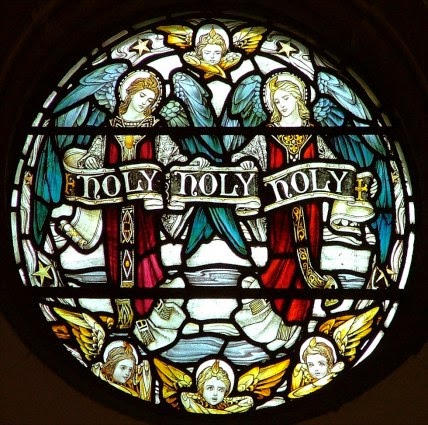
We are also reminded of our union with heaven in the devotional decorations of the church. For example, flanking the Crucifix in our parish church are the panels of Mary and St. John. An icon of the Risen Christ is at the back of the Church. Above are angel banners. In two upper corners of the church are large banners of St. Joseph and the Madonna. And lo and behold, the stain glass windows near the sanctuary have those seraphim, the six winged angels, whom we join in their eternal hymn.
 
Next week: The Sacrifice of the Mass


Thursday, February 5, 2015

#24. What We Give Thanks For in Mass. The Eucharistic Prayer. Understanding the Mass and Its Parts.


In my last post I wrote how the Mass calls us to a lifestyle of gratitude, thankful for the gifts God has given us in love. We hear in the opening Dialogue of the Preface of the Eucharistic Prayer the Priest say "Let us give thanks to the Lord our God." The People say "It is right and just." I wrote how then the Preface prays to God: "It is truly right and just, our duty and our salvation, always and everywhere to give you thanks, Lord, holy Father, almighty and eternal God, through Christ our Lord."
 
What follows in the Preface is itself a thanksgiving to God which is why the Preface is also called the Thanksgiving. What this Preface does is give the reasons why we thank God, for what we thank God. We must also understand that the Priest is praying both for the Church and with the Church and also proclaiming the reasons for thanksgiving. Notice that after the Opeing Dialogue of the Eucharistic Prayer, which is an exchange between the Priest and People, the Preface next speaks to God (as "Lord, holy Father, almighty and eternal God").
 
The Thanksgiving Preface follows the ancient Jewish pattern of prayer where (1) one invokes God, then (2) gratefully proclaims what God has done, typically in creation and in the saving deeds of God and then (3) makes petition to God. The Jewish pattern of prayer, then, first praises and thanks God and then asks for something.


In the Thanksgiving of the Preface we (the Church) go on to state the reasons we thank God in this Eucharist (root word means "thanksgiving"). I also wrote last week a suggestion in preparing for Sunday Mass that we make a list (on paper, or digitally or mentally) of the things we want to thank God for in the Thanksgiving of the Eucharist.


When the Thanksgiving is prayed in the Preface, we unite our personal thanks (silently) to the "cosmic thanksgiving" of Christ himself. We join our thanks to the Liturgy’s thanksgiving typically for creation and for the Paschal Mystery of Christ. The Paschal Mystery refers to the entire life of Christ lived for us and now in us: "Christ enables us to live in him all that he himself lived, and he lives it in us." (Catechism #521)
 
You may read more about the Paschal Mystery HERE, but the essence of the Mystery is the Death and Resurrection of Christ and his Coming again in glory.
 
Consider this Preface of Eucharistic Prayer II which focuses upon both creation and the Paschal Mystery:
 
"It is truly right and just, our duty and our salvation,
always and everywhere to give you thanks, Father most holy,
through your beloved Son, Jesus Christ,
your Word through whom you made all things,
whom you sent as our Savior and Redeemer,
incarnate by the Holy Spirit and born of the Virgin.
Fulfilling your will and gaining for you a holy people,
he stretched out his hands as he endured his Passion,
so as to break the bonds of death and manifest the resurrection."
 
Common Preface V (one of the prefaces that can be used on Week days) states the Paschal Mystery in its simplest summary:
 
"His Death we celebrate in love,
his Resurrection we confess with living faith,
and his Coming in glory we await with unwavering hope."
 
The Eucharistic Preface sometimes focuses on some aspect of the Paschal Mystery/life of Christ which is celebrated in one of the Liturgical Seasons of Advent, Christmas, Lent or Easter. For example, this is a Christmas Preface we pray:
 
"For in the mystery of the Word made flesh
a new light of your glory has shone upon the eyes of our mind,
so that, as we recognize in him God made visible,
we may be caught up through him in love of things invisible."


By having our often humble thanks united to the Great Thanksgiving of the Eucharist, we are "elevated," our hearts truly are lifted up the Lord, and we are given a very dignified role of joining heaven’s eternal Thanksgiving as we will see in next week’s post about the Sanctus.
 
Next Week: Joining the Heavenly Liturgy in the Sanctus (Holy, Holy, Holy) of the Eucharistic Preface.

Thursday, January 15, 2015

#21 The Eucharistic Prayer (Overview). Understanding the Mass and Its Parts.

 
We now come to the actual Eucharistic Prayer which central to the Liturgy of the Eucharist. Previously, I quoted Catechism #1358 which teaches us that
 
"We must therefore consider the Eucharist as:
- thanksgiving and praise to the Father;
- the sacrificial memorial of Christ and his Body;
- the presence of Christ by the power of his word and of his Spirit."
 
I went on to write that the Catechism is actually noting 4 realities here: the Liturgy of the Eucharist is (1) thanksgiving and praise to the Father; (2) the sacrifice of Christ, (3) the memorial of Christ; and (4) the Presence of Christ (under the signs of the Consecrated Bread and Wine).
 
Eucharistic Prayer III of the Roman Missal also refers to these four primary realities; after the Consecration of the Bread and Wine whereby Christ is Really Present, the Priest prays:
 
"Therefore, O Lord, as we celebrate the memorial
of the saving Passion of your Son,
his wondrous Resurrection
and Ascension into heaven,
and as we look forward to his second coming,
we offer you in thanksgiving
this holy and living sacrifice."
 
You may wish to review my previous post on these four aspects of the Liturgy of the Eucharist (HERE).
 
 
We should expect, then, to find these 4 Primary Realities manifested in the Eucharistic Prayer, i.e. Presence, Praise and Thanksgiving, Sacrifice and Memorial. I shall spend time each week describing how these realities are found in the Eucharistic Prayer and the meaning of this for our Catholic Christian lives.
 
Here is the overview of the structure of the Eucharistic Prayer as described in The General Instruction of the Roman Missal. I will note in red the Primary Realities of the Eucharistic Prayer discussed above: Presence of Christ, Praise and Thanksgiving, Sacrifice and Memorial (Remembrance) and highlight them in the following quote.
 
The General Instruction of the Roman Missal (no. 79) provides the following summary of the Eucharistic Prayer:
 
"The main elements of which the Eucharistic Prayer consists may be distinguished from one another in this way:
 
"a) The Thanksgiving (expressed especially in the Preface), in which the Priest, in the name of the whole of the holy people, glorifies God the Father and gives thanks to him for the whole work of salvation or for some particular aspect of it, according to the varying day, festivity, or time of year.
 
"b) The Acclamation [which is Praise], by which the whole congregation, joining with the heavenly powers, sings the Sanctus (Holy, Holy, Holy). This acclamation, which constitutes part of the Eucharistic Prayer itself, is pronounced by all the people with the Priest.
 
"c) The Epiclesis, in which, by means of particular invocations, the Church implores the power of the Holy Spirit that the gifts offered by human hands be consecrated, that is, become Christ's Body and Blood [in his Real Presence], and that the unblemished sacrificial Victim [Sacrifice] to be consumed in Communion may be for the salvation of those who will partake of it.
 
"d) The Institution Narrative and Consecration, by which, by means of the words and actions of Christ, that Sacrifice is effected which Christ himself instituted during the Last Supper, when he offered his Body and Blood under the species of bread and wine, gave them to the Apostles to eat and drink, and leaving with the latter the command to perpetuate this same mystery [Memorial].
 
"e) The Anamnesis, by which the Church, fulfilling the command that she received from Christ the Lord through the Apostles, celebrates the Memorial of Christ, recalling especially his blessed Passion, glorious Resurrection, and Ascension into heaven.
 
"f) The Oblation [Sacrifice], by which, in this very Memorial, the Church, in particular that gathered here and now, offers the unblemished sacrificial Victim in the Holy Spirit to the Father. The Church's intention, indeed, is that the faithful not only offer this unblemished sacrificial Victim but also learn to offer their very selves, and so day by day to be brought, through the mediation of Christ, into unity with God and with each other, so that God may at last be all in all.
 
"g) The Intercessions, by which expression is given to the fact that the Eucharist is celebrated in communion with the whole Church, of both heaven and of earth, and that the oblation [Sacrifice] is made for her and for all her members, living and dead, who are called to participate in the redemption and salvation purchased by the Body and Blood of Christ.
 
h") The concluding Doxology [Praise], by which the glorification of God is expressed and which is affirmed and concluded by the people's acclamation 'Amen.'"
 
 Next Week: The Thanksgiving of the Eucharistic Prayer (in the Preface)