

This reflection also includes descriptions of the Three Paschal Holy Days which we celebrate this week and which also celebrate the Passover Mystery of Christ.
The entire Mass celebrates the Passover Mystery of Christ (aka the Paschal Mystery; Paschal is the adjective of Passover and of Easter). You may read about the associations of the Jewish Passover which are fulfilled in Christ’s Passover in last week’s reflection (HERE). The entire salvation that God offers to us in Christ Jesus is summed up the central reality of the Paschal Mystery: the Dying and Rising of Christ. Consequently, in union with Christ through Baptism and in following him, we are called to this dying an rising spiritually in this life, and physically in the life of heaven.
The Jewish Passover is a "covenant meal," celebrated once a year For more on "Covenant" see HERE). The Passover of Christ and his New Covenant are celebrated whenever the Mass is celebrated. The Eucharist is the "Paschal Banquet" of the Church. (see Catechism #1323 HERE)

|
On the evening of Holy Thursday Lent ends and the Three Paschal Holy Days begin. This celebration commemorates the Last Supper of Christ with his disciples and the gift of his Eucharist to us. The First Reading of this liturgy recalls the Passover of the Israelites. The Gospel proclaims: "Before the feast of Passover, Jesus knew that his hour had come to pass from this world to the Father. He loved his own in the world and he loved them to the end." (John 13:1)
At the last Supper, which anticipates his Death and Resurrection. The Eucharist remembers how Jesus loves us, summed up in a new commandment: "Love one another as I have loved you." (John 13:34) This is a sacrificial love and a love that serves as Jesus demonstrates in washing the feet of his disciples, an act of a servant. The Church uses the details of John 13 to proclaim the meaning of the Eucharist for all times through the ministry of Priests and the participation of the entire Church.
|
After the Consecration at Mass, the Eucharistic Prayer has a Memorial Acclamation (the "Mystery of Faith") and continues with what is called the Memorial of the Paschal Mystery (technically called by its Greek name "anamnesis") and the Offering of the One Sacrifice of Christ in the Mass.
The Memorial is the Spirit-filled remembrance that really makes present the Death and Resurrection of Christ in the Eucharist. In a way this Memorial Prayer is revealing the meaning of the words of Jesus in the Consecration.
Every Eucharistic Prayer has a specific Memorial prayer of the Paschal Mystery. Every Eucharistic Prayer also has the Offering of the One Sacrifice on the Cross and Christ’s Resurrection made sacramentally present on the Altar. (This "offering’ should not be confused with the "Offertory" which occurs before the Consecration and is preparing the gifts of bread and wine for Consecration and Offering)

There are three options for the Memorial Acclamation, the "Mystery of Faith," after the Consecration:
1. "We proclaim your Death, O Lord,
and profess your Resurrection
until you come again."
2. "When we eat this Bread and drink this Cup,
we proclaim your Death, O Lord, [the Resurrection is implied]
until you come again."
3. "Save us, Savior of the world,
for by your Cross and Resurrection
you have set us free."
The Memorial Prayer of Eucharistic Prayer III is quite good as a summary of what we are doing in the Mass:
"Therefore, O Lord,
as we celebrate the memorialof the saving Passion of your Son,
his wondrous Resurrection
and Ascension into heaven,
and as we look forward to his second coming,
we offer you in thanksgiving
this holy and living sacrifice."
|
Holy Thursday is actually a vigil for Good Friday and calculating time in the Jewish manner, i.e. where a day is calculated as including the evening before, Holy Thursday and Good Friday make one day, the First Day of the Paschal Three Days.
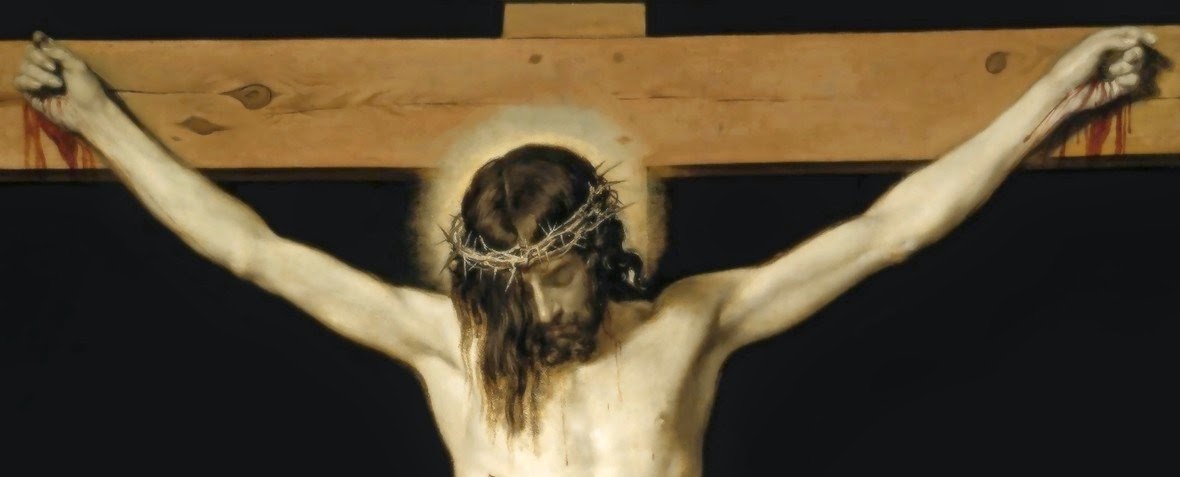
It is fitting that the evening of Holy Thursday and Good Friday are linked together. The Lord Jesus gave us the new commandment to love one another on Holy Thursday evening at his Last Supper. This love, which is sacrificial and all-giving, is demonstrated by his Passion and Death on the Cross:
"[S]ince he was about to offer himself on the cross to save us, he wanted us to have the memorial of the love with which he loved us ‘to the end,’ even to the giving of his life. In his Eucharistic presence he remains mysteriously in our midst as the one who loved us and gave himself up for us, and he remains under signs that express and communicate this love..." (Catechism #1330)
On Good Friday we have the Veneration of the Cross whereby we embrace the sacrificial love of Christ in our lives which the Cross represents, even if we may have to suffer as he did in this life. We would normally have this Veneration of the Cross at 3pm on Good Friday (the hour Christ died; see Matthew 27:45). However, so that more people can attend the Good Friday Service we have it at 7pm at Holy Faith.
|
The Son of God could not have suffered and died for us on the Cross if he had not taken our flesh and was born of the Virgin Mary. He is thus fully God and fully human. He came to die for our sins and as a result of our sins. Thus he suffered our greatest suffering: our experience of death and its loss. Then he was buried in the Tomb.

The Second Day of the Paschal Three Days is Holy Saturday. No Liturgy is celebrated on this day, except Morning Prayer, because on "Holy Saturday the Church is, as it were, at the Lord's tomb, meditating on his passion and death, and on his descent into hell, and awaiting his resurrection with prayer and fasting." (Paschales Solemnitatis #73) This is a day for deep silence and reflection, pondering all the times in life when everything seems "dead and buried."
|
There is no Cross without the Resurrection and no Resurrection without the Cross. In times past the Church focused more on the sacrifice of Christ on the Cross present in the celebration of the Mass and not so much on the Resurrection of Christ. The Memorial of Christ’s Paschal Mystery after the Consecration is a constant reminder of the unity of Christ’s Death and Resurrection.
What role does the Resurrection have in the Christian life? It is the promise and experience of transformation in our lives. It is a radical newness, what St. Paul calls "a new creation." It is in the spiritual sense the promise that darkness will give way to light, death will give way to life, sorrow will give way to joy. Since the Cross tells us that Christ died for us out of sacrificial love,
the Resurrection tells us that this sacrificial love never ends, for Chris himself did not come to an end at his death, and neither shall we.
As one author asserts: "And it is what Jesus’ resurrection means that really matters. For what it means is that if Jesus rose from the dead, so will we. If he overcame the trials, sufferings and hardships of his life, so will we. As he left his tomb, so too can we leave our tombs of sadness, loneliness, addiction, abuse, depression, anger, anxiety, worry, jealousy, envy, and whatever else weighs us down in our daily lives. As Jesus tells us in Scripture: ‘Have courage, I has overcome the world.’" (From Catholic Webprofessor)

|
The Third Day of the Paschal Three Holy Days is the close of Holy Saturday with the night celebration of the Easter Vigil and the start of Easter Sunday.
The Easter Vigil is unique of all the liturgies of the Church. It is reminiscent of the night vigils of the early Church when Christians would gather and light the night lamps and read Scriptures and await the coming of the Lord Jesus.
At the Easter Vigil we light the Paschal Candle which represents Christ our Light. We bring it into the darkened church and light the candles of the Assembly. An ancient hymn is sung (the Exultet) introducing this Vigil. We then hear a number of Scripture readings about creation and salvation, including about Baptism and then the Resurrection of Christ from the dead.
On this night we baptize adults and older children who have been preparing for this. We Confirm them and share the Eucharist with them for the first time. It is a night of joy, to say the least and of great beauty.
The following morning at dawn, the Mass of the Resurrection is celebrated. It was early before dawn that Christ rose from the dead. Other Easter morning Masses follow. As on the night before at the Easter Vigil, the People gathered for the Easter Masses renew their Baptismal promises and also unite with the risen Christ in the Eucharist.
|
Next Week: The Offering of the One Sacrifice of Christ in the Mass in more detail.
Return to Home Page

.jpg)



